The Weather in the Room: A Soho Foley Artist’s Guide to Believable Heartbreak
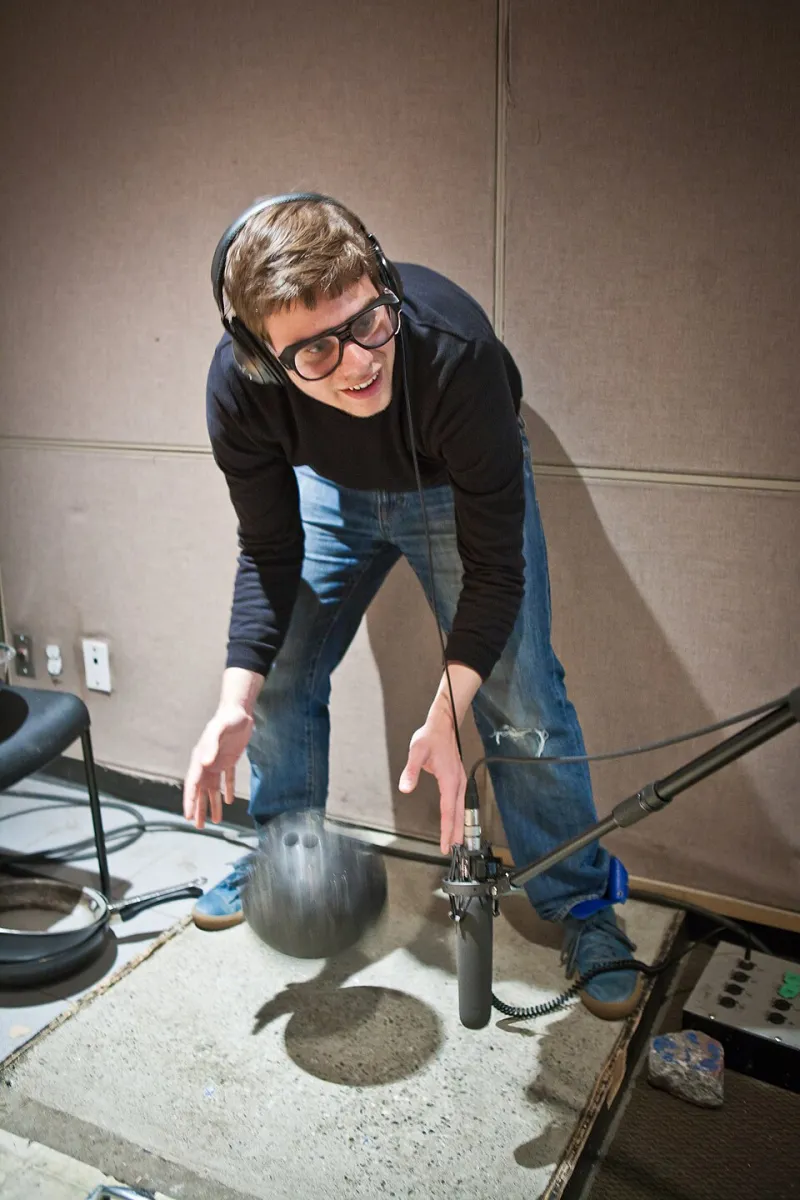
Photo: Vancouver Film School, CC BY 2.0, via Wikimedia Commons
On a grey November morning in 2026, the rain in Soho is doing that familiar London thing: falling sideways, bouncing off bin lids, making everyone walk a little faster. Inside a narrow studio off Berwick Street, another kind of rain is being made. It comes from a hotplate.
Mara Quinn is leaning over a battered electric ring, a tray of rice grains at her elbow and a small watering can within reach. On the screen in front of her, a character stands at a window. On the headphones, the scene is silent. Mara waits for the cue, then tips a handful of rice onto the hotplate. It hisses and spits. She moves the watering can closer. The sound shifts from a light drizzle to a proper soak. It is, somehow, exactly the weather outside.
‘People think Foley is about big noises,’ she says, lifting the headphones from one ear. ‘It is really about tiny ones. The big stuff is already there. I am here for the coat sleeve, the cup, the breath before the lie.’
Foley — named after Jack Foley, the American sound pioneer who began creating synchronised effects for film in the early twentieth century — is the art of performing everyday sound in time with pictures. In 2026, it is having a quiet moment in the spotlight. UK dramas are leaning into intimacy: long close-ups, domestic silences, arguments conducted in kitchens. And the sounds that make those scenes land are often made by hand, in rooms like this one, by people who would rather you did not notice them at all.
The hotplate that sounds like a downpour
Mara’s studio is part workshop, part junk shop, part instrument. There are shoes lined up by the door — leather brogues, trainers with worn soles, a pair of heels that look like they have survived a wedding and a row. There is a tray of gravel, a box of crockery, a bunch of celery kept for the crunch of bones or the snap of a stalk. And there is the hotplate, which she describes as her most reliable leading lady.
‘Rain is never one sound,’ she says. ‘It is layers. You have the hiss on the hotplate, the patter of rice, the heavier splashes from the watering can. If it is rain on a window, I might use fingertips on a pane. If it is rain on a car roof, it is a different rhythm entirely. You have to think about what the audience is feeling, not just what they are hearing.’
She demonstrates a scene from a fictional drama: a woman waiting for a phone call, standing in a hallway while rain lashes the front door. Mara cups a hand over a microphone and taps a fingernail against a mug. The tap becomes the clock. A soft brush of fabric becomes the woman’s sleeve. The hotplate rain fades under it all. It is oddly moving, even without the picture.
Footsteps with a backstory
Footsteps are the next lesson. Mara has a shallow tray of gravel, a square of parquet, a strip of carpet and a slab of concrete. She watches an actor cross a room and then recreates the walk, shoe by shoe, in real time. The trick is not just the surface. It is the mood.
‘A confident walk lands differently from a nervous one,’ she says. ‘You can hear hesitation. You can hear someone trying not to be heard. If a character is lying, I might make the footsteps a little too even. If they are exhausted, I drag the heel slightly. The audience does not know why they feel uneasy, but they do.’
She is especially fond of scenes set in British homes: the click of a kettle, the shuffle of slippers on stairs, the clink of a spoon against a mug. These are the sounds of ordinary life, and in a tense drama they become small pressure points. A door closing softly can be more frightening than a door slammed.
A heartbeat you can almost hear
When the scene calls for something more visceral, Mara turns to the body. A heartbeat can be made with a gloved fist against a padded chest, or a leather cushion struck with the flat of a hand. Breathing is performed close to the microphone, sometimes with a hand cupped over the mouth to shape the air. A kiss is not a kiss; it is a pair of lips pressed to a wrist, a breath, a rustle of cotton.
‘Heartbreak is mostly breath,’ she says. ‘The catch before a cry. The swallow. The moment someone decides not to say the thing they are desperate to say. I can spend an hour on a single sob. It is not glamorous, but if it is wrong, the whole scene collapses.’
Why nobody should notice
In 2026, Foley is in demand for a very practical reason: streaming has made viewers ruthless about fake sound. Libraries of generic effects are easy to spot. A door that sounds like every other door pulls you out of the story. A rainstorm that sounds like a static hiss feels like a rainstorm from a different programme. Producers want specificity: the particular squeak of a particular hinge, the particular clink of a particular teacup.
Mara likes the pressure. She likes being given a scene and a box of props and told to find the truth in it. She likes the quiet concentration of the room, the way everyone stops talking when the red light goes on. But she also admits that the job can be lonely. You spend hours listening to things nobody else will ever hear on their own.
‘The best compliment is silence,’ she says. ‘If nobody mentions the sound, we have done it right. But every so often someone says, “That rain felt so real.” And I think, yes. That was a hotplate and a bag of rice. That was a Tuesday in Soho.’
As I leave, the real rain has stopped. Mara is already setting up for the next cue, headphones on, hand hovering over the hotplate. In the corner of the room, a kettle clicks. It sounds exactly like the start of something.