Curtain Up at the Window: The Bath Bookshop That Stages a New Play Every Month
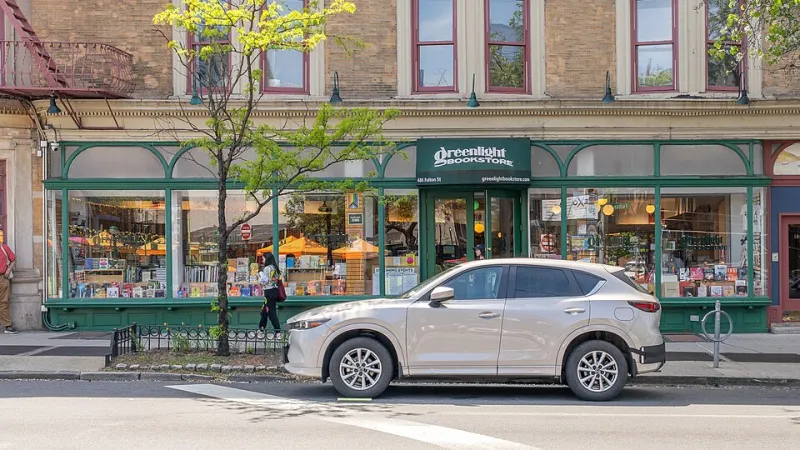
Photo: ajay_suresh, CC BY 4.0, via Wikimedia Commons
The window of Lark Hill Books, on a side street near Bath’s Margaret’s Buildings, is not large. It is the kind of window you might walk past without noticing, unless you are the sort of person who notices windows. This month, it contains a miniature stage: a paper proscenium arch, a red curtain made from an old scarf, and a tiny audience of folded programmes. In the middle of it all sits a single book, open at the page where the heroine first walks on.
Imogen, 42, has run the shop since 2021. She is a bookseller by trade and a set designer by instinct. Every month, she clears the window, gets out her glue gun, and builds a new scene. Sometimes it celebrates a touring show at the Theatre Royal Bath. Sometimes it is a tribute to the Ustinov Studio. Sometimes it is a local amateur production that nobody outside Bath has heard of, which is exactly why she does it.
‘The window is a stage,’ she says. ‘It has a frame, it has an audience, and it has a curtain. You might as well use it.’
The window as a stage
She thinks in sightlines. A child walking past with a parent sees the bottom third. An adult sees the middle. Someone on a bus sees the top. So the important things go low: the tiny chairs, the paper footlights, the little printed tickets scattered on the floor. The book goes at eye level. The joke — because there is always a joke — goes somewhere you have to stop to find.
This month’s joke is a tiny review pinned to the proscenium arch. It reads: ‘A triumph of card and sellotape.’ Imogen wrote it herself.
The current window is a celebration of Bath’s theatre season, though it is not an advert. There are no logos, no posters, no QR codes. Instead, there is a paper model of a stage with a miniature lighting rig made from cocktail sticks and a borrowed doll’s-house lamp. The programmes are real, donated by customers. The red scarf belonged to Imogen’s grandmother. The tiny audience is made from folded tickets, each one a different colour.
‘People think it’s about the book,’ she says. ‘It’s not. It’s about the feeling of going to the theatre. The anticipation. The programme. The seat. The lights going down.’
Paper, glue and borrowed ghosts
The sets take two days to build. Imogen works on Mondays, when the shop is closed, with the radio on and the cat, Mabel, asleep in the stockroom. She uses cardboard from deliveries, wallpaper samples from a shop down the road, and old programmes from a box under the counter. Nothing is valuable. Everything can be replaced.
She has rules. No real flames. No borrowed props that have to be returned before the window comes down. No set that takes longer to build than it does to look at. ‘I learned that the hard way,’ she says. ‘I once spent three days on a papier-mâché chandelier. It fell over in the night. The window looked like a crime scene.’
The best props come from people. A retired stage manager lends her a tiny hammer. A customer brings in a box of old ticket stubs. A local theatre company lets her borrow a model chair from their production of a Chekhov play, on the condition that she mentions them in the window. She does, in tiny letters, at the bottom, where only the very curious will see.
‘It’s a conversation,’ she says. ‘The window talks to the street. The street talks back. People come in to say they saw it. They don’t always buy a book. That’s fine. They’ve stopped. That’s the first thing.’
The quiet drama of a high street
In 2026, independent bookshops are not just shops. They are rooms for slowness. They are places where you can stand for ten minutes and read the first page of something without being asked if you need help. The window is part of that. It is a small, handmade argument for paying attention.
Bath’s Christmas Market is already busy. The streets are full of people carrying paper cups and looking at their phones. The window offers something else: a pause. A tiny world. A reminder that a high street is not just a row of transactions. It is a stage, too.
Imogen does not know what next month’s window will be. She has an idea about a snowstorm made from hole-punched paper and a miniature box office. She has a pile of old programmes from a pantomime. She has a roll of red ribbon that is definitely not festive but might be.
‘I like the making,’ she says. ‘I like the fact that it’s temporary. You build it, you look at it, you take it down. It’s a little production. It has a run. It has an audience. Then it’s gone.’
As I leave, a woman stops outside the window and laughs at the tiny review. Her child presses a nose to the glass. Mabel the cat appears in the shop doorway, considers the scene, and goes back inside. The curtain, made from a scarf, does not move. But for a moment, the whole street feels like it is watching.