The First Face and the Last Look: A Manchester Makeup Artist on Selling a Period Drama One Freckle at a Time
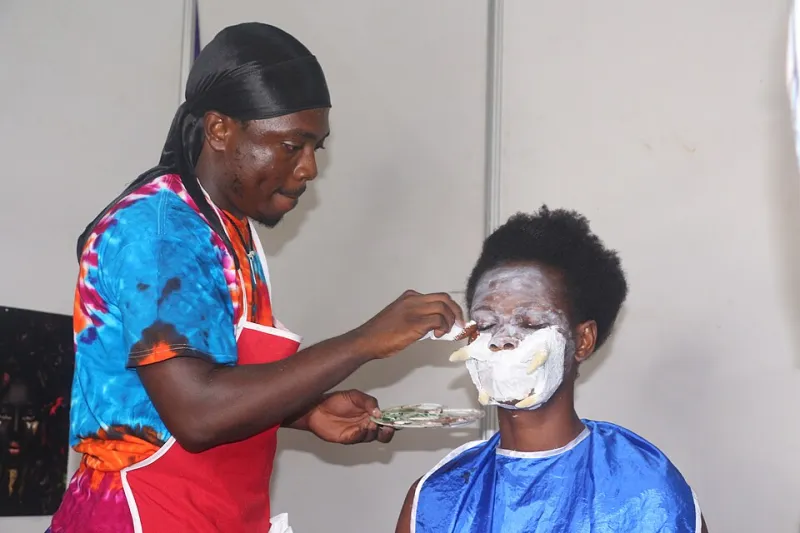
Photo: Fquasie, CC BY-SA 4.0, via Wikimedia Commons
The trailer door opens at 5:42am and the first thing you notice is not the mirrors or the bulbs, but the smell of coffee and the sound of a kettle that has clearly been on since before dawn. Nadia Ashworth is already there, a pencil tucked behind her ear and a black notebook open on the counter. “This is the bible,” she says, tapping the cover. “Everything else is negotiable. This isn’t.”
Nadia is a film makeup artist based in Manchester. Today she is working on a six-part British period drama shooting in and around the city in 2026 — a story of mill towns, wet pavements and people who have spent too long standing at bus stops in the rain. Her job is not to make the cast look pretty. It is to make them look real, and then to make them look exactly the same kind of real three weeks later when the schedule jumps backwards and they are suddenly shooting the first scene of episode two after the last scene of episode five.
The Notebook That Does the Heavy Lifting
The book is not glamorous. It is a hardback sketchbook, the kind you might buy in a stationery shop on Oldham Street, and it is full of tiny diagrams. There are page markers, a coffee ring on the corner, and a code in the margin that only Nadia and her continuity assistant understand.
She opens it to a double page labelled “ELLEN — WEATHERING”. Ellen is the lead, a woman who runs a household and a small business and does not have time to think about whether her skin looks tired. The page shows a pencil drawing of a face, with dots across the nose and cheeks and a small scar above the left eyebrow. Next to it: “freckle cluster 3 — stronger after rain scenes — do not add to right cheek until ep 4”.
“Freckles are a nightmare,” Nadia says, laughing. “They are not symmetrical. They fade. They get covered in mud. And if you add one in the wrong place, a very nice person on the internet will notice.”
She uses a mix of fine pencils, a stippling sponge and a sheer tint to build the freckles, layering them so they look like they have been there for years rather than applied at 6am. There is also a “wind map” — small red marks on the cheeks and nose that indicate where the skin has been beaten by weather. In one episode, Ellen spends a lot of time outside. In another, she doesn’t. The notebook has to track that difference, because the shooting order does not.
Trailer Rituals and the Ten-Minute Rule
The first actor arrives at 6:15. Nadia has a rule: nobody talks about the scene until the base is on. “It gives them a minute,” she says. “They come in with the script in their head, and I just put my hands on their face and we breathe for a second. It sounds ridiculous, but it works.”
The trailer is small and warm. There is a radio playing low, a rail of costumes behind a curtain, and a shelf of products that looks less like a beauty counter and more like a chemist’s drawer. Nadia works quickly, but she does not rush. She asks about sleep, about the journey, about whether the coffee has kicked in. She checks the light in the mirror against the light on set. She does not do anything dramatic. She does small things, repeatedly, until they add up.
“The first and last person an actor sees before a take is me,” she says. “That’s a responsibility. If I’m frantic, they feel it. If I’m calm, they borrow it.”
The Close-Up Test
The real work happens in the ten minutes before a close-up. The camera moves in, the focus puller does their thing, and suddenly a freckle that was fine on a wide shot looks like a blemish. Nadia steps in with a tiny brush and a powder puff. She does not cover the freckles. She softens around them. She adds a little redness to the nose if the scene is cold. She lifts a tiny bit of shine from the forehead, then puts some back on the cheekbone because the character is supposed to be a bit sweaty.
“You are not painting a face,” she says. “You are telling the camera where to look. A close-up is a conversation. I just try to make sure the actor is doing the talking.”
She checks the notebook again. There is a note from three weeks ago: “Ellen — left cheek scar — lighter after hospital scene — do not forget”. She picks up a fine brush and touches it in, then blends it with her finger. It takes less than a minute. It sells the whole episode.
The Last Look
The actor comes back from set at lunchtime, and Nadia is there again, powdering the nose, checking the collar, adjusting a hairpin that has slipped. The morning’s freckles are still exactly where they should be. The scar is still on the left cheek. The weather on her face matches the weather in the scene, even though the sun is now out over the Manchester rooftops.
“People think it’s about vanity,” Nadia says. “It’s not. It’s about trust. The actor trusts me to keep the story straight on their face. The director trusts me to keep the continuity. And the audience trusts us all to not ruin the illusion.”
She closes the notebook. The kettle goes on again. There is another actor in the chair at 1:30, another map of freckles, another day of tiny details that no one will notice and everyone will feel. And that, she says, is the whole job.