The Words Under the Laughter: A Saturday Night Beside Salford’s Live Subtitler
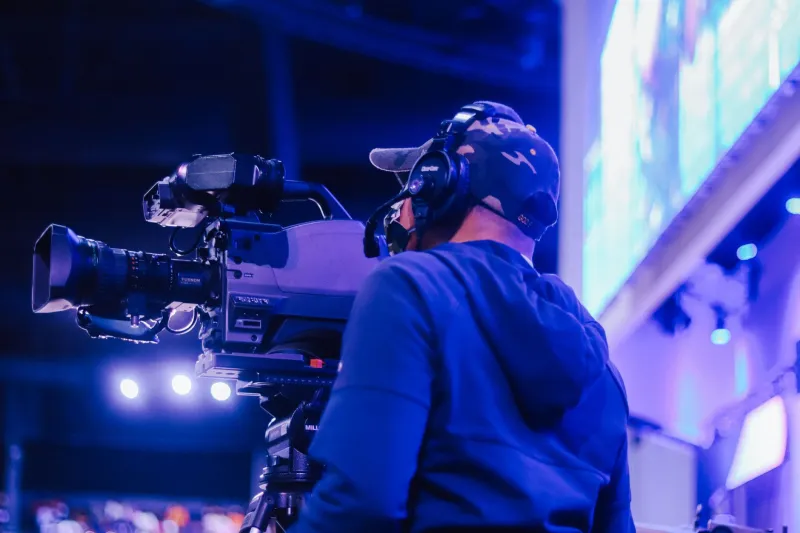
At 6.42 on a damp Saturday evening in Salford, the Quays are doing their usual impersonation of a film set: glass, water, blurred lights and people walking briskly with lanyards. Inside one of the broadcast buildings, Lena is not walking briskly. She is sitting very still in a small prep room with a mug of tea going cold beside her keyboard, reading a running order as if it were a poem she has to learn by heart.
Tonight she will caption a big Saturday-night entertainment show as it goes out live. Not later, not for the catch-up service, not after a careful edit. As the jokes land, the falls happen and a celebrity forgets the name of their own dog, Lena will be turning all of it into words on screen. The viewers who need her will see the programme through her fingertips and her voice. Most of them will never know her name.
The prep before the noise
Live subtitling is often described as typing, which is a bit like describing a penalty shoot-out as kicking. Lena uses a technique called respeaking: she listens to the programme through headphones, repeats what she hears into a headset trained on her own voice, and the speech-recognition software turns her words into text. She then corrects the inevitable stumbles, softens the odd misheard syllable and keeps the line moving. It is a performance with no audience in the room and no chance of a second take.
Her prep is meticulous in a quietly obsessive way. She has a pronunciation list for tonight’s guests, marked with the names that look straightforward but are not. There is a note about a comedian who tends to ad-lib during the walk-on. There is another about the host’s habit of saying ‘brilliant’ three times in a row when a contestant does something mildly brave. Lena reads the autocue extracts, skims the press notes and writes out the names of the musical act in block capitals.
‘The names are the trap,’ she says, laughing. ‘You can be sailing along and then someone says a surname that sounds like three other surnames and a weather warning. If you get it wrong, the audience sees it instantly. There is no hiding place in live telly.’
Backstage, with the talkback in one ear
By 7.15 she is in the gallery annexe, a compact space of screens, cables and borrowed chairs. The show’s producer is in her ear through talkback, not constantly but often enough to remind her that the broadcast is a living thing. A pre-recorded segment might run short. A guest might arrive late. Someone in the studio might decide to perform a stunt that was not in the script, which is exactly the sort of thing Saturday-night television thrives on.
Lena’s screen shows the programme feed, a rolling transcript and a delay buffer. The buffer is not a safety net in the cosy sense. It is a few seconds of breathing space, and she has learned to treat those seconds like a currency. Spend too much of it and you fall behind. Hoard it and you lose the natural rhythm of the dialogue. The trick is to stay close enough that the captions feel like they are happening with the show, not trailing after it like a polite relative.
‘People think the pressure is the speed,’ she says. ‘Sometimes it is. But the real pressure is judgement. You have to decide what matters. If two people talk over each other, do you follow the host, the guest or the joke? If someone swears, do you caption it exactly? If the audience laughs for five seconds, do you write that, or do you trust the viewer to hear it?’
The five-second flutter
At 7.58 the countdown ends and the studio erupts. The opening titles are all glitter and drums. Lena’s shoulders drop half an inch. Then they don’t move again for nearly an hour.
Watching her work is strangely soothing. Her voice is low and even, almost monotone, but her hands are busy. A word appears, then another. A contestant says something daft and the caption lands just after the laugh, so the joke still works on screen. The host makes a crack about the weather and Lena catches it cleanly. For a while it feels effortless, which is the point.
Then a guest tells a rambling anecdote about a hotel in Blackpool, and the anecdote has a false start, two interruptions and a punchline involving a seagull. Lena’s transcription wobbles. She corrects mid-sentence, deletes, restarts, keeps going. On screen, the viewer sees a clean line. In the annexe, there is a tiny flurry of breath and a soft tap of the keyboard. That is the whole drama.
‘You are the viewer’s companion,’ she says afterwards. ‘That is how I think of it. If someone is watching with the sound off, or they are Deaf, or they are in a noisy room, I am the person sitting next to them saying, this is what happened, this is what it felt like. That is a strange kind of intimacy. You have to be honest with it.’
The quiet after the credits
The show ends at 9.05. The credits roll, the studio audience is marshalled towards the exits, and the gallery begins its post-mortem. Lena stays for a few minutes, checking the log for obvious howlers. There is one name she wants to double-check. There is a joke she abbreviated because the timing was tight. She makes a note for next week, because there will be a next week.
Outside, the Quays are still glassy and bright. Somewhere in the building, a floor manager is eating a late sandwich. Lena puts her headphones in her bag and pulls on her coat. She has spent the evening in the middle of a party she could not attend, translating it one line at a time. It is not glamorous work. But for the viewers at home, it is the difference between watching and being left out — and that feels like a very 2026 kind of magic.
As she walks towards the tram, she is already thinking about next Saturday’s running order. There will be new names to learn, new ad-libs to survive, new five-second flutters. She would not have it any other way.